







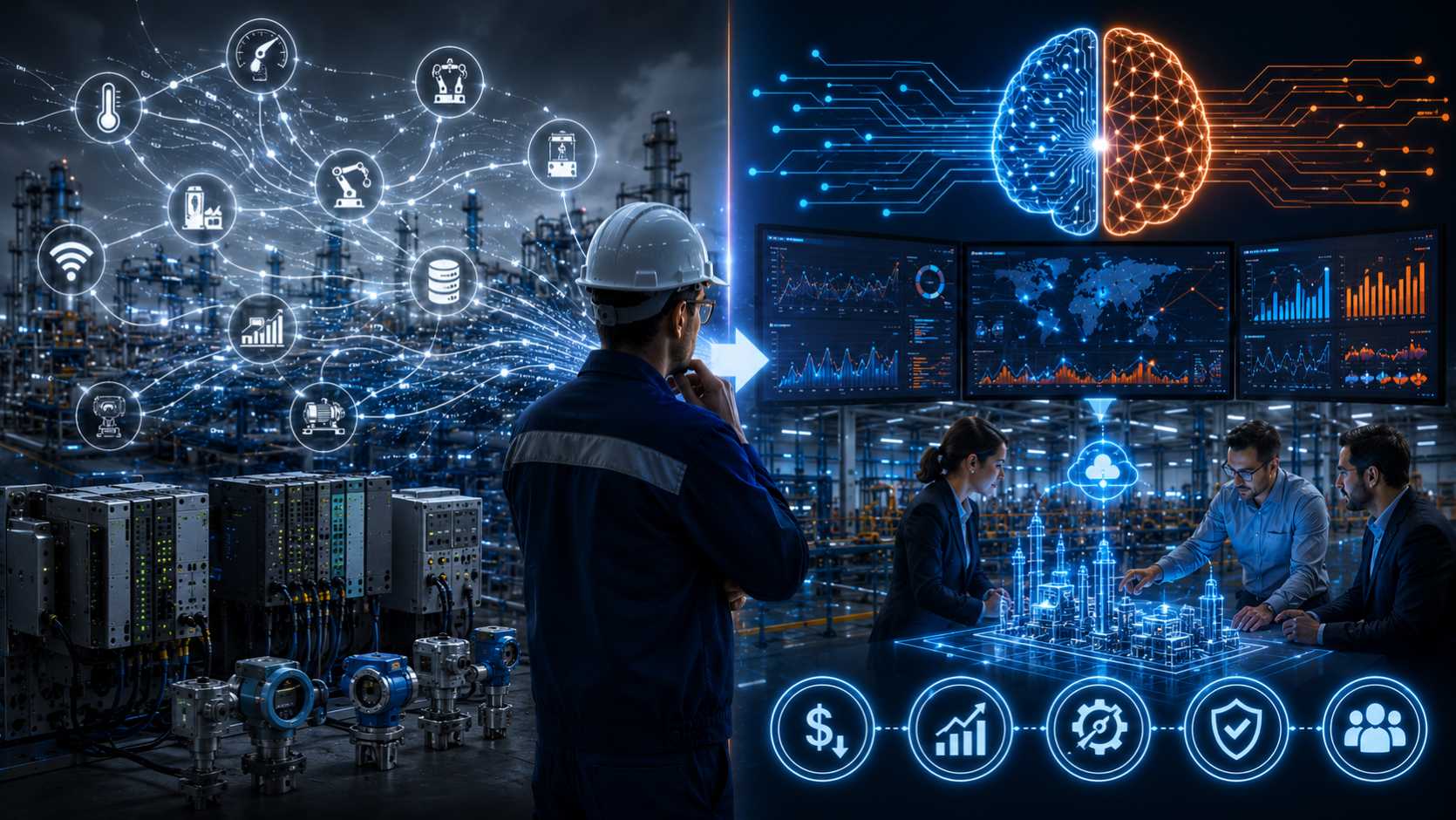
Manufacturers have invested heavily in Industrial IoT technologies over the past decade. Sensors, connected equipment, edge devices, PLCs, and cloud platforms now generate enormous amounts of operational data every second.
Yet many organizations continue to ask the same question:
Why hasn’t our Industrial IoT investment delivered measurable business value?
The answer is rarely the hardware or the software platform.
The real issue is the absence of operational context.
Collecting millions of sensor readings does not automatically improve production, reduce costs, or increase efficiency. Data becomes valuable only when it explains what happened, why it happened, and what action should be taken next.
Successful Industrial IoT Development focuses on transforming raw telemetry into meaningful operational intelligence that supports better business decisions.
At Seashore Solutions, we help manufacturers build Industrial IoT ecosystems that connect physical assets, industrial controls, enterprise software, and analytics into a unified operational platform designed for long-term growth.
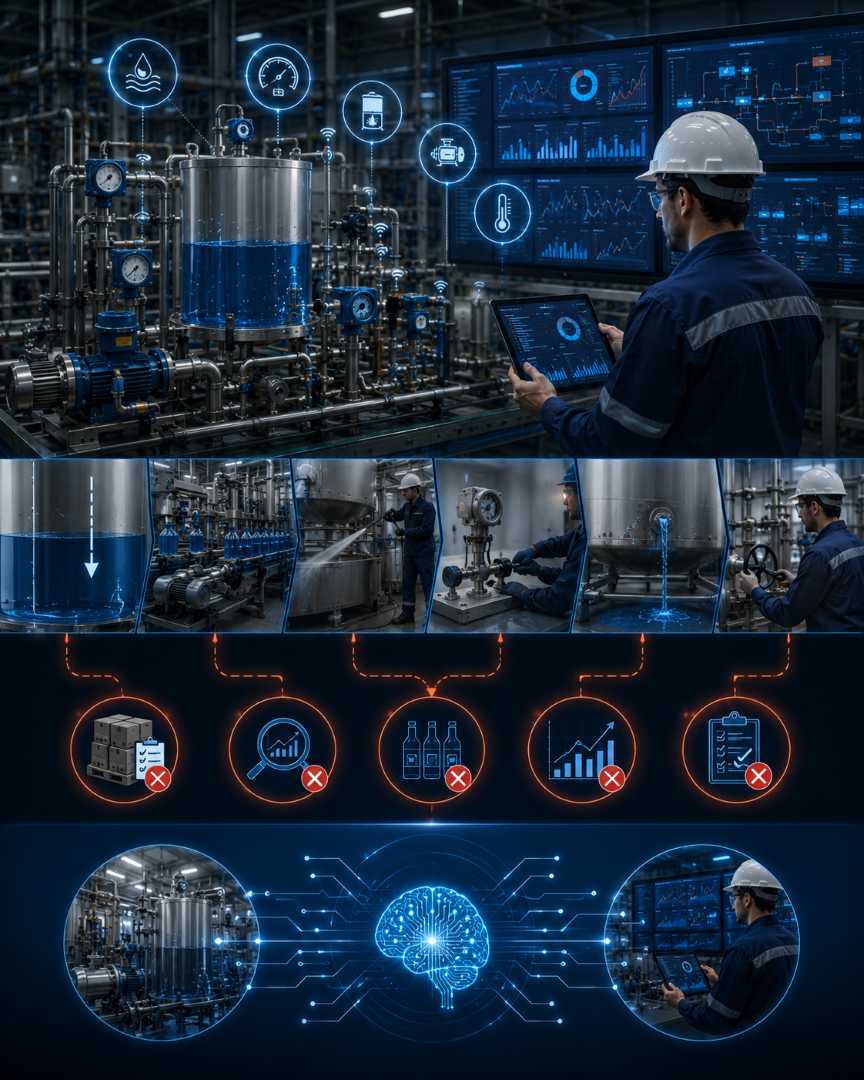
Every Manufacturing Facility Has Data Very Few Have Intelligence
Modern manufacturing facilities are equipped with connected devices that continuously collect operational information.
Typical data sources include:
- Flow meters
- Pressure sensors
- Temperature transmitters
- PLCs
- SCADA systems
- Edge gateways
- Cloud data platforms
While these systems successfully capture data, they often fail to deliver meaningful operational insights.
Organizations typically experience the same pattern:
- Sensors are installed.
- Dashboards are created.
- Data is collected continuously.
- Reports are generated.
Several months later, dashboards receive little attention because they provide information without context.
The technology works.
The business value does not.
Understanding the Difference Between Data and Operational Intelligence
Consider a flow meter displaying a reading of 2.7 Gallons Per Minute. Although technically accurate, this measurement alone provides limited value.
Now place the same reading into operational context. When the system identifies the product as a premium beverage concentrate, associates it with batch number #2026-1745, and links it to production line 3, the data becomes more meaningful. If the expected flow rate is 3.0 GPM and the actual flow rate is 2.7 GPM, the system can calculate a 10% deviation and estimate a yield impact of 4.8%.
Suddenly, the information becomes actionable. Production managers can investigate performance issues, quality teams can verify process consistency, maintenance teams can inspect equipment, and operations leaders can evaluate productivity.
The difference is not the sensor it is the context. This principle forms the foundation of every successful Operational Intelligence Platform.
Why Operational Context Matters in Liquid Processing Systems
Liquid processing and dispensing operations generate vast amounts of sensor data. These environments rely on a combination of flow meters, pressure sensors, tank monitoring systems, automated dispensing equipment, pump monitoring solutions, and temperature monitoring devices.
Many organizations assume that increasing the number of sensors will automatically improve visibility. However, operational reality is far more complex.
A change in tank level, for example, does not always indicate product consumption. It may represent normal production activity, inventory usage, cleaning operations, calibration procedures, product leakage, or manual operator intervention. Without understanding the operational state of the equipment, the sensor value alone provides limited business insight.
This lack of context often leads to challenges such as inaccurate inventory reconciliation, unreliable yield analysis, poor batch traceability, ineffective production forecasting, and inconsistent quality reporting.
The missing element in these scenarios is operational context.
The Five-Layer Industrial IoT Architecture
Successful Industrial IoT Platform Development is built on a layered architecture that transforms raw device signals into actionable business intelligence.
Layer 1: Physical Assets
This layer includes:
- Pumps
- Valves
- Flow meters
- Sensors
- Drives
- Dispensing equipment
- Process instrumentation
These assets generate the raw operational signals required for monitoring manufacturing processes.
Layer 2: Control Systems
PLCs and embedded controllers manage the production process by answering questions such as:
- Is production running?
- Is a valve open?
- Is a recipe active?
- Is equipment operating normally?
This layer provides operational state information that gives meaning to raw sensor values.
Layer 3: Edge Intelligence
Edge computing plays a critical role in modern Edge Computing Manufacturing architectures.
Instead of transmitting every sensor reading directly to the cloud, edge platforms perform local processing by:
- Validating data
- Applying business rules
- Detecting anomalies
- Generating operational events
- Maintaining production during network interruptions
Examples of operational events include:
- Batch Started
- Dispense Verified
- Tank Refill Completed
- Production Run Finished
- Equipment Fault Detected
This approach significantly improves data quality while reducing unnecessary cloud traffic.
Layer 4: Operational Data Platform
The operational data platform consolidates information from multiple enterprise systems, including:
- PLCs
- ERP software
- Inventory management systems
- Maintenance platforms
- Quality management applications
- Production databases
The objective is to create a single, trusted source of operational truth.
A strong Industrial Data Architecture enables accurate reporting, enterprise integration, and long-term scalability.
Layer 5: Decision Intelligence
This is where Industrial IoT delivers measurable business value.
Decision intelligence platforms answer questions such as:
- Why has production efficiency declined?
- Which ingredients generate the most waste?
- Which equipment requires maintenance?
- Which production line is most profitable?
- Which facility is operating most efficiently?
At this stage, telemetry becomes operational intelligence that supports faster and better business decisions.
Why Many Predictive Maintenance Projects Underperform
Predictive maintenance is one of the most widely discussed applications of Industrial IoT, yet many initiatives fail to achieve expected outcomes.
The issue is rarely the predictive algorithm itself. Instead, it lies in the underlying data architecture.
A typical pump may provide data such as operating hours, motor current, temperature, pressure, and vibration. While these measurements are valuable, they do not provide a complete picture.
Additional operational context such as the product being processed, expected production rates, cleaning cycles, recent maintenance activities, and equipment operating modes often has greater predictive value.
Successful Predictive Maintenance Software integrates both sensor data and operational context to improve prediction accuracy and reliability.
Industrial IoT and Intelligent Inventory Management
Industrial IoT creates significant opportunities for improving inventory management. Traditional approaches rely on periodic reconciliation, which often results in material shortages, excess inventory, forecasting inaccuracies, and production delays.
Modern Industrial IoT systems continuously monitor ingredient consumption, production output, tank levels, work orders, and purchasing activity. This enables near real-time inventory visibility, allowing organizations to make better purchasing decisions and reduce operational waste.
For manufacturers managing liquid ingredients or process materials, intelligent inventory management can significantly enhance operational efficiency.
Preparing for AI Requires Better Data, Not More Data
Artificial Intelligence is becoming an integral part of modern manufacturing operations. Organizations are exploring applications such as AI-based forecasting, production optimization, intelligent scheduling, predictive maintenance, and process optimization.
However, AI cannot compensate for poor data quality.
Successful Industrial AI Readiness depends on contextualized data, trusted operational history, consistent data models, reliable traceability, and well-designed system integrations.
Manufacturers that invest in strong Industrial IoT architectures today are building the foundation for future AI-driven capabilities.
The Industrial IoT Maturity Model
Most organizations progress through five stages of Industrial IoT maturity.
Stage 1: Connectivity
Devices and equipment become connected.
Stage 2: Visibility
Dashboards provide operational monitoring.
Stage 3: Context
Operational events are modeled and understood.
Stage 4: Intelligence
Analytics influence operational and business decisions.
Stage 5: Optimization
Artificial intelligence continuously improves performance.
Many manufacturers remain at Stages 1 and 2.
The greatest business value begins at Stage 3, where operational context transforms data into actionable intelligence.
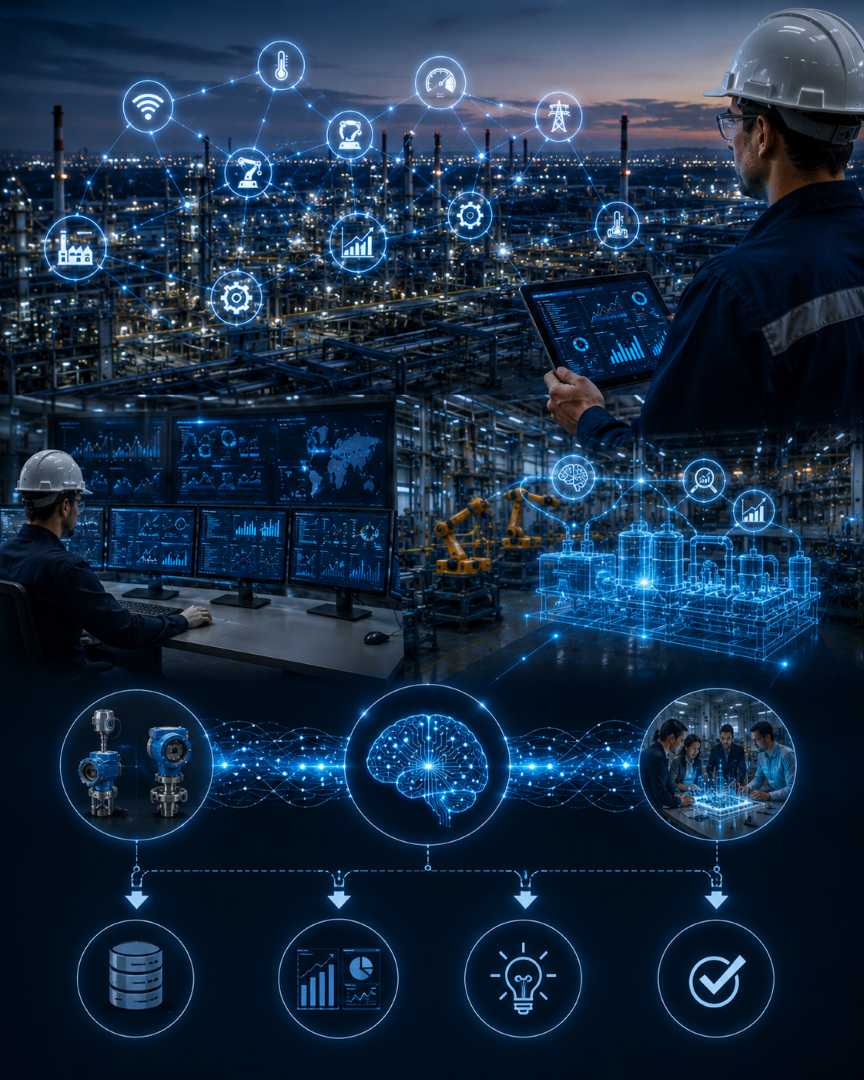
The Future of Industrial IoT
The future of Industrial IoT will not be defined by the number of connected sensors or dashboards, as these capabilities are rapidly becoming standard across manufacturing.
Organizations that achieve long-term competitive advantage will be those that successfully transform physical process behavior into operational intelligence.
Modern Smart Manufacturing Solutions will go beyond reporting what happened. They will provide insights into why events occurred, what those events mean, and what actions should be taken next.
This transition from telemetry to intelligence is what makes Industrial IoT truly transformative.
Conclusion
Industrial IoT is no longer about simply connecting devices.
Its true value lies in creating operational context that enables better decision-making across manufacturing, maintenance, inventory management, and enterprise operations.
By combining Industrial IoT Development, Edge Computing Manufacturing, Manufacturing Analytics, and intelligent operational architectures, manufacturers can unlock measurable improvements in productivity, efficiency, and profitability.
At Seashore Solutions, we design scalable Industrial IoT platforms that bridge operational technology and enterprise systems, helping manufacturers transform raw operational data into actionable business intelligence and long-term competitive advantage.
About Seashore Solutions
Seashore Solutions specializes in Industrial IoT Development, Industrial Automation Software Development, PLC Integration, Manufacturing Analytics, Operational Intelligence Platforms, Liquid Management Systems, and Enterprise Software Integration.
Our engineering teams help manufacturers design connected ecosystems that integrate industrial controls, edge computing, cloud platforms, analytics, and enterprise applications into scalable, future-ready solutions that drive measurable business outcomes.