
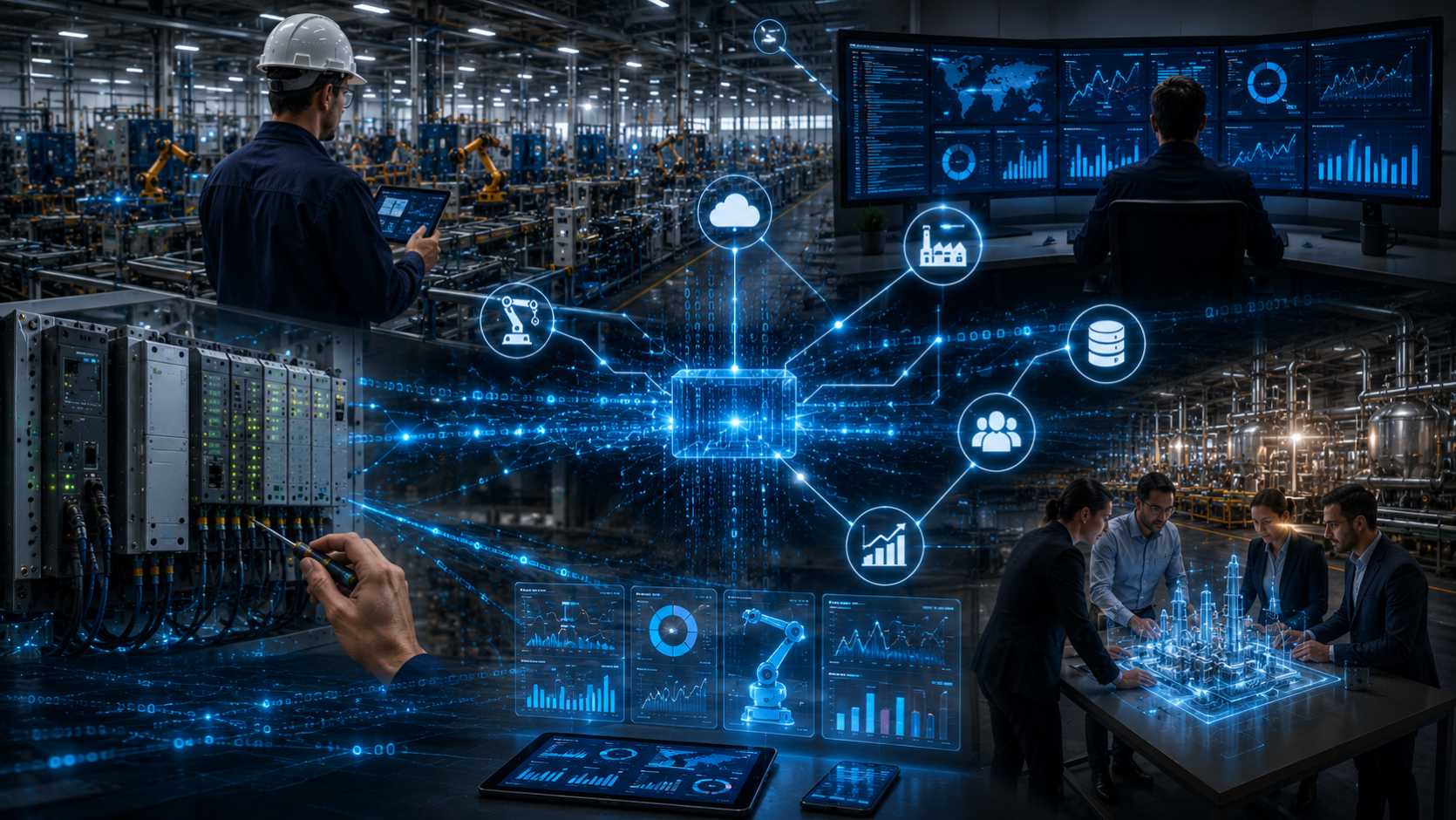
Manufacturers are investing heavily in digital transformation, Industrial IoT, and smart factory initiatives. Despite this, many PLC integration projects fail to deliver meaningful business outcomes.
The issue is rarely the PLC, the communication protocol, or the hardware.
The real problem is a lack of operational context.
Most organizations focus on collecting data instead of understanding it. Successful PLC Integration Services go beyond connectivity they require a well-designed architecture that connects machines, systems, and business processes into a unified ecosystem.
At Seashore Solutions, we help manufacturers build scalable integration frameworks that turn raw data into actionable insights, improving efficiency, visibility, and long-term performance.
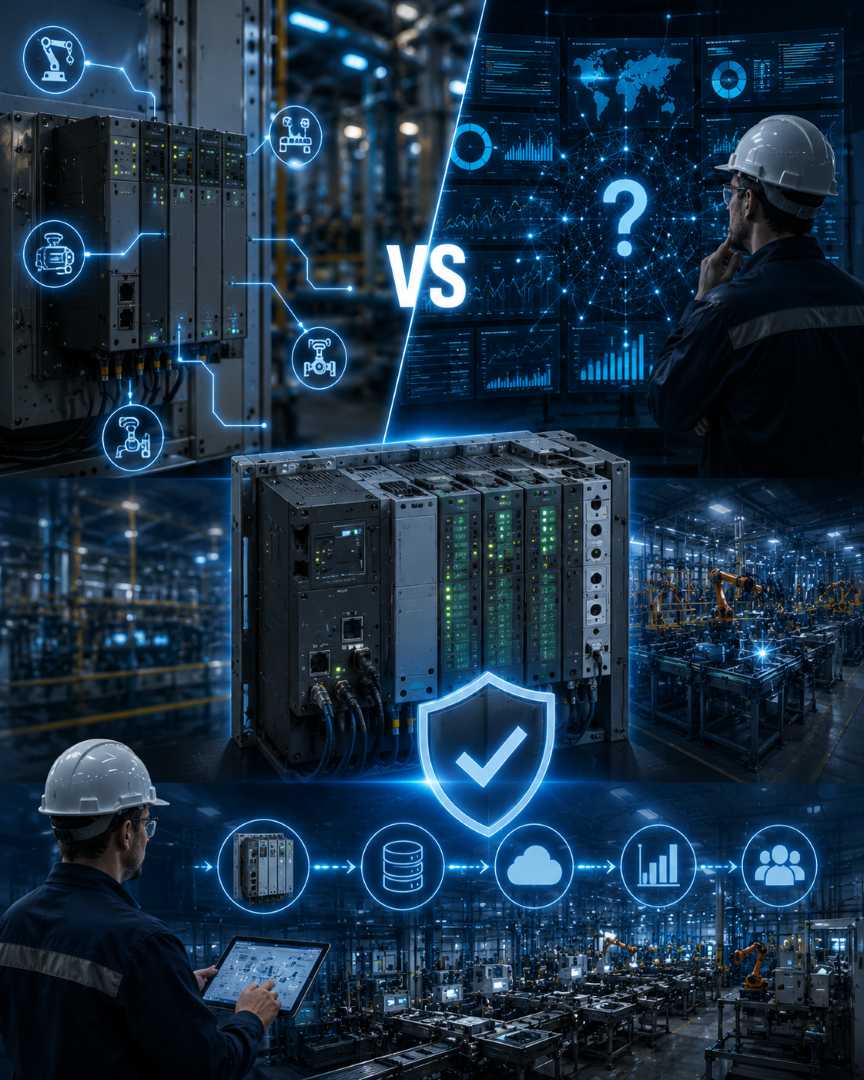
The PLC Is Not the Problem
Modern PLCs are highly reliable and perform their intended functions exceptionally well.
Common platforms include:
- Allen-Bradley ControlLogix and CompactLogix
- Siemens S7
- Schneider Electric
- Beckhoff
- Omron
- Mitsubishi
These systems are designed to:
- Control machinery
- Execute automation logic
- Monitor processes
- Respond to events
- Ensure operational safety
The problem arises when PLCs are expected to act as enterprise data systems.
PLCs control equipment they do not provide business context.
Recognizing this distinction is essential for effective Industrial System Integration.
The Missing Piece: Operational Context
Consider a simple PLC value:
Tank_Level = 72%
While accurate, this value alone has limited meaning.
Different departments interpret it differently:
- Operations: Available production capacity
- Inventory: Current stock level
- Procurement: Reorder planning
- Finance: Inventory valuation
- Maintenance: Consumption patterns
- Quality: Traceability
Without context, data cannot drive decisions.
This is why successful integration focuses on meaning—not just measurement.
Why Tag Mapping Alone Fails
A typical integration approach looks like this:
- Connect PLCs
- Extract tags
- Store data
- Build dashboards
The result?
- Large volumes of data
- Complex reports
- Minimal actionable insight
Tags alone are not business information.
Data becomes valuable only when linked to:
- Production batches
- Recipes
- Product SKUs
- Operators
- Equipment states
- Work orders
This is the foundation of modern Manufacturing Data Architecture.
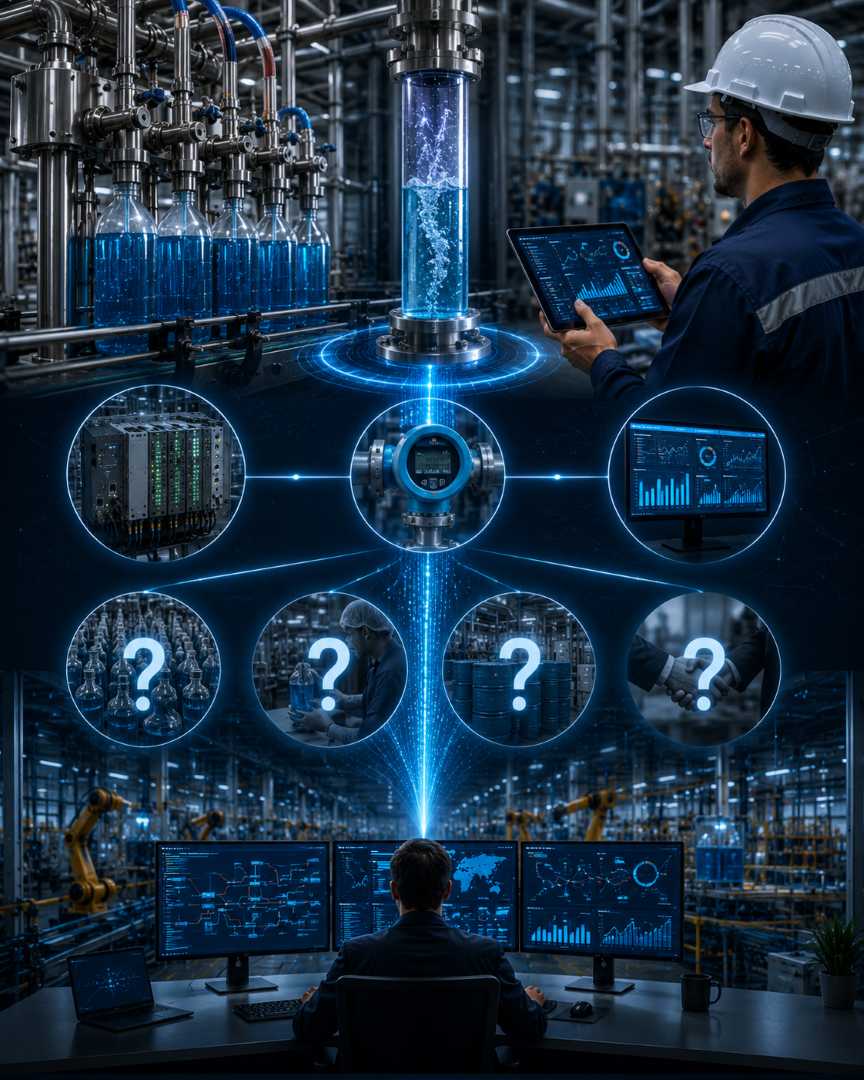
Real-World Example: Liquid Dispensing Systems
In liquid processing environments, this issue becomes even more apparent.
Facilities often invest in:
- Flow meters
- Pressure sensors
- Temperature systems
- Tank monitoring
- Pump controls
- Automated dispensing
While the hardware performs well, the software layer often lacks context.
For example:
4.7 Gallons Dispensed
This raises critical questions:
- What material was dispensed?
- Which recipe was used?
- Which order triggered it?
- Who performed the action?
- Was it accurate?
- Did inventory update correctly?
Without answers, the data is incomplete.
This is why strong Manufacturing Software Integration is essential.
-
Moving from Data to Events
Modern systems are shifting toward event-driven architectures.
Instead of sending raw values, systems communicate meaningful events such as:
- Batch Started
- Batch Completed
- Dispense Verified
- Tank Refilled
- Equipment Fault
Events provide:
- Clear context
- Better traceability
- Easier integration
- Improved scalability
Business systems, analytics tools, and ERP platforms all work better with events than raw data.
-
The Role of a Unified Data Model
As systems grow, inconsistencies in naming and structure create integration challenges.
For example:
- PLC: Tank_01
- ERP: Raw Material Vessel A
- Maintenance: Asset #4008
- Analytics: Storage Location 1
Without standardization, integrations become complex and fragile.
A canonical data model solves this by creating a single, consistent structure across systems.
Benefits include:
- Improved reporting
- Simplified integrations
- Better traceability
- Reduced maintenance
This is critical for scalable Industrial Control Systems Integration.
-
Understanding ISA-95 in Practical Terms
ISA-95 is one of the most important standards in manufacturing integration.
It defines how operational technology and business systems should communicate.
A simplified ISA-95 architecture is organized into the following levels:
- Level 0 – Physical Processes: The actual manufacturing or production process
- Level 1 – Sensors and Devices: Instruments that measure and interact with the process
- Level 2 – Control Systems: PLCs and automation systems that control equipment
- Level 3 – Operations Management: Systems that manage production workflows and operations
- Level 4 – Business Systems: Enterprise systems such as ERP
Most integration challenges occur between Levels 2, 3, and 4.
The PLC understands machines.
The ERP understands business operations.
The integration layer connects the two.
This is where architecture becomes more important than technology alone.
-
OPC-UA, MQTT, and REST APIs: Choosing the Right Technology
One of the most common questions engineering teams ask is:
Should we use OPC-UA or MQTT?
The answer is often:
Both.
Because each technology serves a different purpose.
OPC-UA Integration
Best suited for:
- Industrial interoperability
- Structured data models
- Secure device communication
- OT environments
MQTT
Ideal for:
- Event-driven systems
- Edge computing architectures
- Cloud communication
- Industrial IoT deployments
REST APIs
Best suited for:
- ERP integrations
- Enterprise applications
- Business workflows
- User-facing software
The most effective Industrial Connectivity strategies combine these technologies to create a flexible and scalable architecture.
-
Why Cybersecurity Must Be Part of the Design
As OT and IT environments become increasingly connected, cybersecurity has become a business requirement.
Modern PLC integration architectures should include:
- Role-based access control
- Device authentication
- Data encryption
- Audit logging
- Secure gateways
- Network segmentation
Security should not be treated as an afterthought.
It must be built into the architecture from the beginning.
-
Preparing for AI and Predictive Manufacturing
Manufacturers are increasingly exploring:
- Predictive maintenance
- AI-driven optimization
- Digital twins
- Operational intelligence
- Autonomous manufacturing
However, AI depends on data quality.
Reliable AI requires:
- Operational context
- Traceability
- Consistent data models
- Historical production data
- Accurate system integrations
Organizations achieving the greatest success with AI are often those that invested in strong integration architectures years earlier.
AI readiness begins with a solid foundation of ERP PLC Integration and operational data management.
-
The PLC Integration Maturity Model
Successful manufacturers typically progress through five distinct stages of integration maturity:
Level 1: Connectivity
Devices are successfully connected, enabling basic data exchange between systems.
Level 2: Visibility
Operational data is visualized through dashboards, providing insights into system performance.
Level 3: Context
Data is enriched with operational context, allowing events and processes to be clearly understood.
Level 4: Intelligence
Advanced analytics are applied to support informed business decisions and improve efficiency.
Level 5: Optimization
Artificial intelligence and automation continuously optimize operations and drive performance improvements.
Many organizations remain at Levels 1 and 2, focusing primarily on connectivity and visibility.
Industry leaders, however, advance to Levels 4 and 5, leveraging intelligence and optimization to achieve competitive advantage.
Final Thoughts
The future of manufacturing is not determined by how many devices are connected.
It is determined by how effectively information flows across the organization.
Successful PLC Integration Services projects are not simply connectivity initiatives.
They are data architecture projects that connect:
- Industrial controls
- Enterprise systems
- Operational workflows
- Business intelligence
- Analytics platforms
- Future AI initiatives
Organizations that understand this distinction create scalable systems capable of supporting long-term growth and digital transformation.
Those that do not often find themselves repeatedly rebuilding integrations as business needs evolve.
The real question is no longer:
Can your PLCs communicate?
The real question is:
Can your architecture transform operational data into business value?
About Seashore Solutions
Seashore Solutions specializes in PLC Integration Services, Industrial IoT, Industrial Automation Software Development, Liquid Management Systems, Enterprise Integrations, and Manufacturing Analytics.
Our engineering teams help organizations bridge the gap between operational technology and business systems by creating scalable architectures that improve visibility, increase efficiency, and support future digital transformation initiatives.
If your organization is evaluating PLC Integration Services, OT/IT modernization, Industrial IoT projects, or enterprise integration initiatives, Seashore Solutions can help design an architecture built for long-term success.