
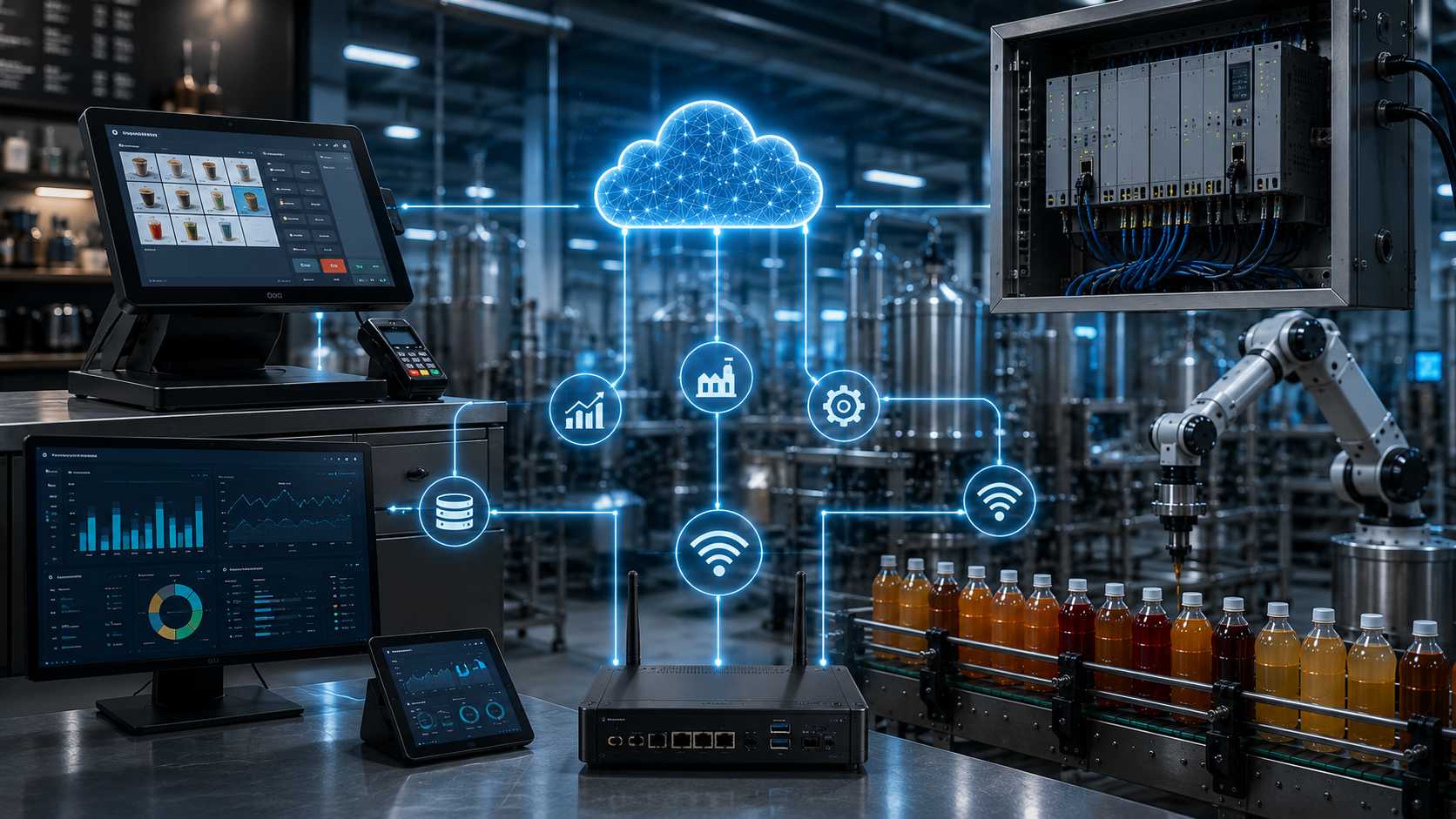
In today’s food and beverage industry, operational efficiency is no longer achieved by implementing standalone software or advanced machinery alone. Modern operations rely on the seamless interaction of multiple technologies including Point-of-Sale (POS) systems, Programmable Logic Controllers (PLCs), IoT devices, ERP platforms, payment gateways, and cloud analytics solutions.
While each system may perform effectively on its own, the real challenge lies in ensuring they communicate reliably and work together as one integrated ecosystem. Organizations that invest in robust POS integration software, PLC software integration, and ERP integration services gain better visibility, higher efficiency, and improved customer experiences.
This article explores the architecture, challenges, and best practices for integrating POS, PLC, IoT, and ERP systems within food and beverage operations.
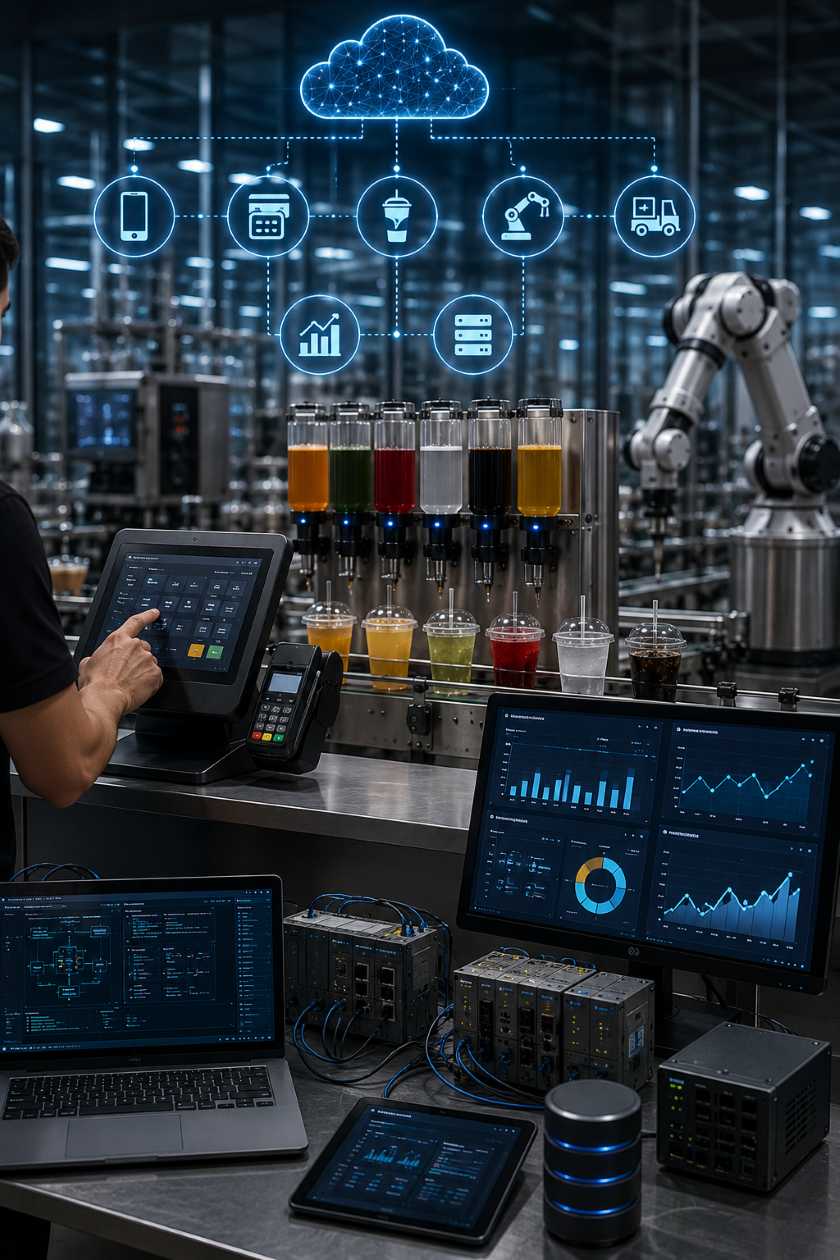
Why System Integration Matters in Food & Beverage Operations
A modern beverage or food service environment involves far more than processing customer orders. Behind every transaction, multiple systems exchange information in real time.
A typical workflow may include:
- Customer places an order through the POS.
- Payment gateway authorizes the transaction.
- Recipe management software validates the product configuration.
- PLC-controlled equipment executes dispensing or preparation.
- Inventory levels are automatically updated.
- Sales data is sent to reporting systems.
- ERP platforms synchronize financial and operational records.
If any step fails, businesses may face:
- Revenue leakage
- Inventory discrepancies
- Delayed service
- Customer dissatisfaction
- Compliance and audit issues
This is why industrial system integration has become a strategic investment rather than a purely technical requirement.
Common Challenges in Food and Beverage Integrations
Many businesses expand their technology stack gradually. Over time, they accumulate systems from different vendors that were not originally designed to work together.
Common integration challenges include:
-
1. Different Communication Protocols
-
2. Data Format Differences
-
3. Real-Time Processing Requirements
Event-Driven Architecture for Scalable Integration
Traditional point-to-point integrations create complexity as businesses grow.
For example:
- POS directly communicates with PLC.
- PLC communicates with inventory software.
- Inventory software connects to ERP.
- ERP connects to analytics.
As new systems are added, maintenance becomes increasingly difficult.
A better approach is event-driven architecture.
In this model, systems publish events such as:
- OrderCreated
- PaymentCompleted
- DrinkDispensed
- InventoryUpdated
- DeviceOffline
Other systems subscribe to these events and react independently.
Benefits include:
- Loose coupling between systems
- Improved scalability
- Easier maintenance
- Faster deployment of new features
- Better fault isolation
This architecture has become a core principle of modern enterprise system integration.
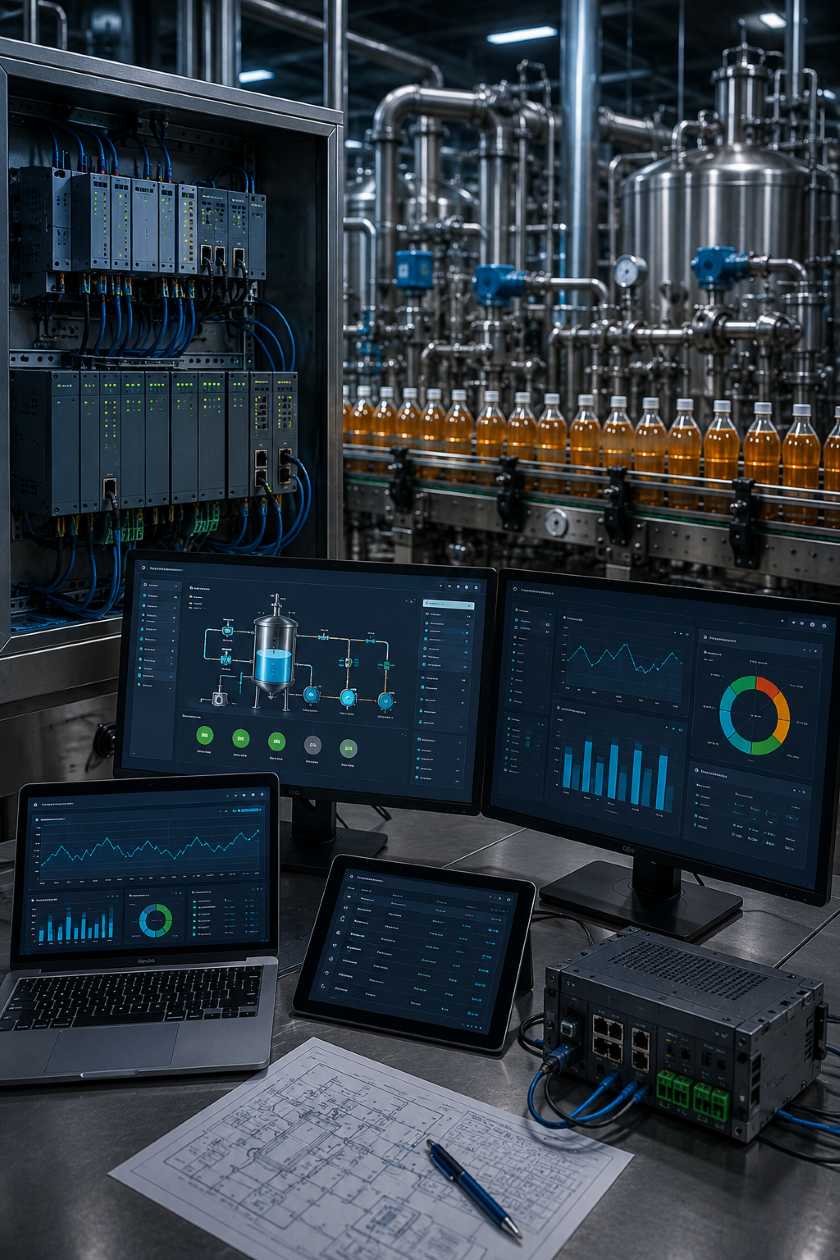
PLC Software Integration: Bridging Industrial Equipment and Business Systems
PLCs control many critical operations in beverage environments, including:
- Pumps
- Valves
- Flow meters
- Temperature control
- Mixing systems
- Pressure monitoring
However, integrating PLCs with enterprise software presents unique challenges.
Successful PLC software integration requires:
Protocol Abstraction
Applications should communicate through a standardized interface instead of directly interacting with device-specific protocols.
Fault Tolerance
The system should gracefully handle:
- Device disconnections
- Communication timeouts
- Network interruptions
- Hardware failures
State Synchronization
Software and hardware must maintain consistent operational states to avoid dispensing errors and inaccurate reporting.
Timestamp Normalization
Accurate timestamps across devices improve traceability, diagnostics, and compliance reporting.
By abstracting PLC complexity from business applications, engineering teams create more maintainable and scalable systems.
-
IoT Integration Platform for Real-Time Monitoring
-
Predictive Maintenance Through Industrial IoT Architecture
-
ERP Integration Services for Inventory and Financial Accuracy
-
Security Considerations for Connected Food & Beverage Systems
-
Best Practices for Industrial System Integration
The Future of Food and Beverage Integrations
The future of food and beverage operations will be shaped by connected systems rather than isolated applications.
Organizations that successfully integrate:
- POS systems
- PLC-controlled equipment
- IoT devices
- ERP platforms
- Cloud analytics
- Mobile ordering solutions
will gain greater operational visibility, higher efficiency, and improved customer experiences.
The most successful companies are not necessarily deploying more software.
They are building smarter architectures that allow their existing systems to work together seamlessly.
Conclusion
Integrating POS, PLC, IoT, and ERP systems is no longer optional for modern food and beverage operations. Businesses require reliable, scalable, and secure architectures that connect operational technology with enterprise software.
By investing in POS integration software, PLC software integration, ERP integration services, and advanced IoT integration platforms, organizations can streamline operations, improve accuracy, and create a strong foundation for future growth.
The companies that treat integration as strategic infrastructure today will be best positioned to lead tomorrow’s food and beverage industry.